
Strategic Planning Facilitation in Raleigh
Strategic planning facilitation is the work of running a leadership team’s planning session so the people who have to decide can spend the day deciding. TranscenDecisions, the leadership coaching firm that built Transcend Leadership Center, facilitates annual planning sessions, quarterly sessions, leadership offsites, and board sessions for CEOs and their teams in Raleigh.
What Does an Effective Strategic Planning Session Look Like?
An effective strategic planning session ends with fewer priorities than it started with, and every one of them has a name and a date next to it. The team leaves with a one-year plan everyone can state the same way. It also leaves with a 90-day plan and a decision on the one or two issues that had been circling for months.
A bad strategic planning session is easy to recognize. Twenty initiatives nobody owns. A plan that reflects whoever spoke first and loudest. A CEO who spent the day managing the clock and the agenda and never got to think. An offsite that produced a deck no one opened again. Teams that leave with 20 to-dos do none of them.
Across thousands of executive and board meetings, TranscenDecisions coaches have seen that the sessions that held up share four things.
- The decisions the day had to produce were named before anyone walked in
- The hard conversation was scheduled, not hoped for
- Nothing was called decided until it had an owner and a date
- The person running the room was not the person whose plan it was
What Is a Strategic Planning Facilitator?
A strategic planning facilitator is an outside professional who designs and runs a leadership team’s planning session: the agenda, the discussion, the decision process, and the record of who owns what. The leaders supply the judgment and make every call. The facilitator supplies the structure, keeps the time, and keeps the room honest.
A facilitator is not a consultant. A consultant brings an answer. A facilitator brings a process that gets the team to its own answer, which is the kind of plan a leadership team owns. In a planning session the facilitator’s job is to stay out of the content and inside the process.
A facilitator is also not an internal leader with a flip chart. An internal leader has a stake in the outcome, a boss in the room, and a reputation to protect. The team knows it, and it changes what gets said. An outside facilitator can ask the question the room has been avoiding because the facilitator does not have to live with the politics afterward.
Why Should the CEO Not Run the Planning Session?
A CEO who runs the planning session is doing two jobs that compete. One is managing the agenda, the clock, the quiet people, and the loud ones. The other is thinking about the hardest questions the company faces. The second job loses. Three findings from outside the room point the same way.
The leader talks the most and grades the meeting highest
Meeting scientist Nale Lehmann-Willenbrock of the University of Hamburg reports that the leader is often the person who talks most in a meeting, and the one most likely to call it a good meeting. Liana Kreamer of UNC Charlotte advises leaders to lead the meeting without dominating it.
The first opinion anchors the room
Daniel Kahneman’s work on anchoring explains a pattern facilitators see constantly: the first number spoken sets the range for everything that follows. When the CEO speaks first, the team edits the CEO’s view instead of forming its own. The fix is procedural, and it is in the decision method below.
Only 30% of board leaders strongly agree their strategy talks end in decisions
That is the finding of the National Association of Corporate Directors’ 2026 private-company survey. It is a process problem, and process is the facilitator’s job.
How TranscenDecisions Runs a Strategic Planning Session
This is the method TranscenDecisions coaches use for annual planning sessions, quarterly sessions, leadership offsites, and board sessions. It is built for the leadership team of a founder-led or private company, and it fits inside whatever planning rhythm the company already runs.
-
Name the decisions first
Before the date is set, the facilitator and the CEO agree on what the session has to decide. The agenda is built backward from those decisions. If the list is longer than the day, the session is longer or the list is shorter.
-
Pre-work before the room
Numbers, scorecards, and the questions each leader will answer go out ahead of time, so the meeting starts from the numbers, not a recap. Everyone arrives having already written down what they think.
-
Check in, then set the rules
Every session opens with one question each leader answers in turn, and with the ground rules the room agrees to. The check-in is not an icebreaker. It surfaces what each person is carrying in, and it gets every voice into the room in the first 20 minutes.
-
Review before you plan
The team reviews the last 90 days and the last year honestly, including what did not happen, before anyone talks about next year. Then the strategic plan is reviewed and updated. Planning without a review repeats the last plan with new dates.
-
Goals, then 90-day priorities, then the hard issues
The order matters. The year’s goals come first, then the priorities for the next 90 days, then the key issues, so the hardest conversation happens with the year’s priorities already on the wall.
-
Close with the record, not the feeling
Nothing leaves the room as a feeling of alignment. It leaves as a written log of decisions, owners, and dates, and that log opens the next session.
What Does the Agenda Look Like?
There is no standard agenda. Every agenda is built backward from the goal of the meeting, so an annual planning session, a quarterly session, a board session, and a leadership offsite each take a different shape on the wall. The four below are examples of that shape. The agenda for your session is written for your goal, your team, and the decisions the day has to produce.
| Meeting | Goal | Example blocks | What it must produce |
|---|---|---|---|
| Annual planning | Set the year. One to two days. |
|
|
| Quarterly planning | Reset the next 90 days. One day. |
|
|
| Board session | Decide the strategic questions management brought. Half day to one day. |
|
|
| Leadership offsite | Rebuild alignment. One to two days. |
|
|
The Ground Rules the Room Agrees To
TranscenDecisions puts 14 ground rules on the wall at the start of every planning session. The team agrees to them out loud. The facilitator enforces them, which is one more thing the CEO does not have to do.
- Open and honest
- Assume positive intent
- Seek first to understand, then to be understood
- Let the voice in your head speak
- No titles and no egos
- No side conversations
- No excuses. Own it.
- Stay out of the weeds
- Name the elephant
- Work on the business, not in the business
- Call out tangents
- Break together
- No email or texting except on breaks
- Lighten up and have fun
How Are Decisions Made When the Team Splits?
Every planning session reaches a point where the room divides, goes quiet, or defers to the CEO. The decision method is built for that moment, and it runs in five steps the team can later run without a facilitator.
- Frame the question in one sentence on the whiteboard, and agree whether the decision is reversible and what waiting costs
- Put the facts on the table in 10 minutes, with clarifying questions only
- Write before you talk: each leader privately writes the option they favor, their confidence from 0% to 100%, and the one fact that would change their mind, then everyone reveals at once
- Weigh the options out loud, and for each one ask what the team is saying no to by choosing it
- Decide, and record five things: the decision, the single accountable owner, the 90-day milestones, the tripwire that sends it back to the table, and what gets reported next session
- If the facts are thin or the room genuinely splits, defer on purpose: name the gap, who closes it, and the date. A deferral with a date is a decision. A deferral without one is drift.
Why the Room Is Part of the Method
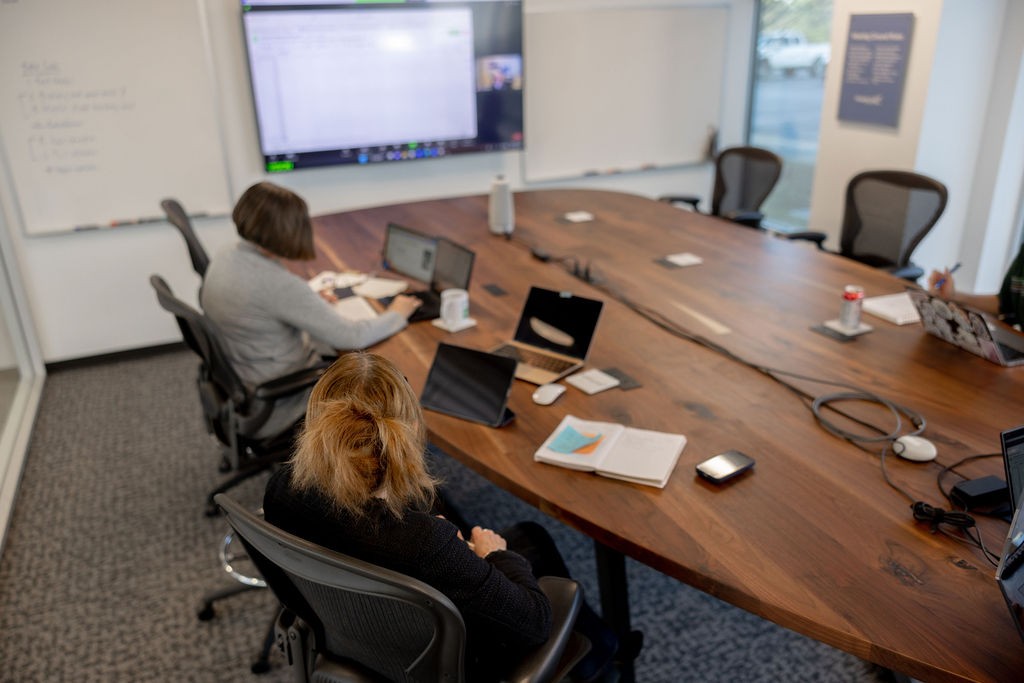
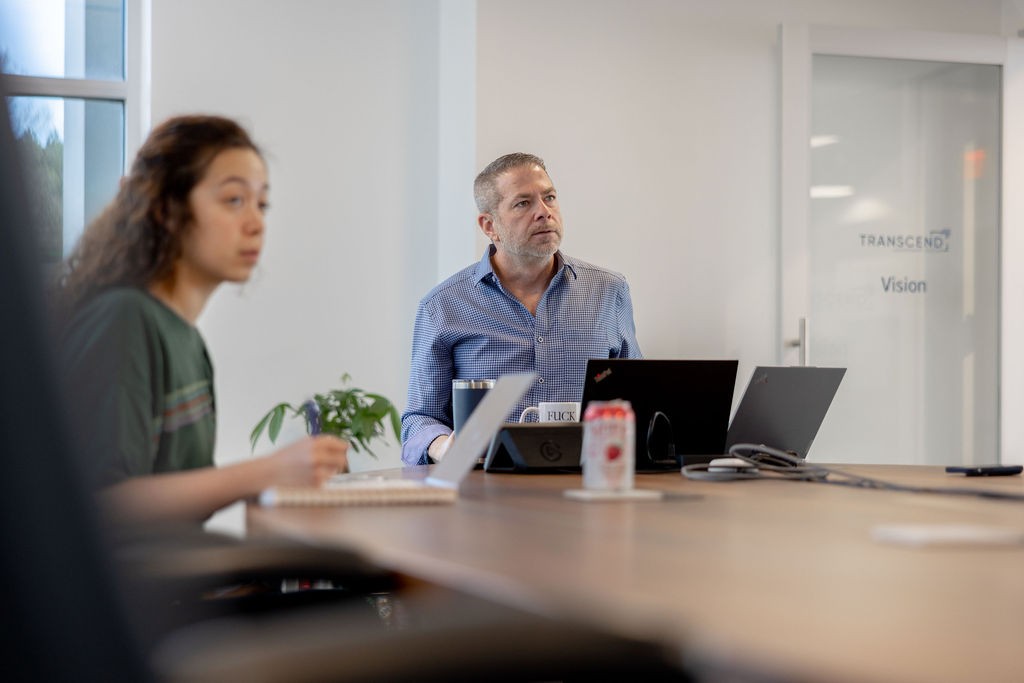
A planning session alternates between working the problem on the wall and deciding at the table, and a room has to support both. A seasoned leadership team coach designed Transcend Leadership Center around the session. Standing-height tables keep the group at one eye level. More than 600 square feet of whiteboard means nothing gets erased to make room. Breakout rooms handle the parts of the day that split the team. On-site staff are there throughout the day, so the facilitator never leaves the conversation.
- The whiteboards and materials stay up overnight on multi-day sessions, so day two starts where day one stopped
- Phones and laptops go down during working blocks, and private phone rooms cover calls during breaks
- Remote leaders join on a 360-degree camera, so they are in the discussion, not watching it
- Travel, hotels, and parking are covered on the Raleigh and Durham location pages
What Do You Walk Away With?
Annual goals with numbers
Three to five goals for the year, each one measurable, each one the whole team can repeat.
Priorities for the next 90 days
The priorities that matter most this quarter, each with a single owner and a definition of done.
The issues decided
The circling issues resolved in the room, or deferred on purpose with an owner and a date.
A decision log within 48 hours
Every decision, owner, and date in one page the team reviews at the next session.
The next dates locked
Quarterly sessions and the next annual retreat on the calendar before anyone leaves.
A method the team keeps
The check-in, the ground rules, and the five-step decision process stay with the team after the facilitator leaves.
How Do You Choose a Strategic Planning Facilitator?
Five questions separate a facilitator who will change the session from one who will narrate it.
Have they run this meeting before?
Ask how many planning sessions they have facilitated for companies your size, and ask for one story about a session that went wrong and what they did.
Will they tell the CEO no?
A facilitator who cannot push back on the person paying the invoice will not push back on anyone else in the room either.
What happens when the room splits?
A good answer is a method, with steps. A bad answer is “we work through it.”
Who writes the record?
If the answer is “your team”, the decisions will not survive the week. The facilitator owns the log.
Are they selling a framework?
A facilitator who arrives with a template will run your session through it. Ask what they do with a team that already has a planning rhythm of its own.
“The team at Transcend understands how environment can impact the meeting and have curated a space that feels great and has everything you need to be focused and productive.”
Matt Lemke
Strategic Planning Facilitation: Questions Leaders Ask
How long is a facilitated strategic planning session?
A quarterly planning session is one day. An annual planning retreat is one to two days, and some leadership teams run two to five days when the strategic plan itself is being rebuilt. The length is set by the decisions the session has to produce.
Who should attend a strategic planning session?
The CEO and the people who own the company’s results, which usually means the leadership team and nobody else. Keep the room to the people who own results; every extra seat slows the decision. Board sessions include the board and the executives who own the questions on the agenda. Anyone who attends has pre-work to do before the day.
How should a CEO prepare for a strategic planning session?
Agree the decisions the session must produce, send the numbers and the scorecard ahead of time, and answer the pre-work questions yourself. Decide in advance to speak last on the questions that matter most. The facilitator handles the agenda, the materials, and the room.
What if my leadership team is stubborn and loud?
The ground rules and the write-before-you-talk step in the decision method do most of the work, so the loudest voice cannot set the frame. The facilitator holds the rules so the CEO does not have to referee.
Can a board meeting be facilitated the same way?
Yes, with a different agenda. A board session is built around the two or three strategic questions management brings, with pre-reads, silent writing on each question, a decision or a dated deferral on each, and an executive session at the end. The ground rules and the decision method are the same.
Can the session be virtual?
A strategic planning session can run virtually, and the method works on a video call with silent writing and a shared whiteboard. In practice the teams that get the most from a planning session are in one room with their phones down, which is why TranscenDecisions built one.
What does strategic planning facilitation cost?
Facilitation is quoted per engagement, based on the number of days, the preparation involved, and the size of the team. Sessions held at Transcend Leadership Center are quoted as one package for the room, the technology, beverages, snacks, and parking. The room is not line-itemed, and no price is published.
Where can I find a strategic planning facilitator near Raleigh?
TranscenDecisions facilitates strategic planning sessions at Transcend Leadership Center, 8041 Arco Corporate Drive, Suite 120, Raleigh, NC 27617. It serves leadership teams across the Triangle and teams that fly in.
Plan your time at TLC
Request a Quote for a Facilitated Planning Session
Tell us the decisions your next planning session has to produce, your dates, and your headcount. You will get a quote for the facilitation and a separate quote for the room.
Or call 984-263-7373